You slide the heavy, enameled machine across your kitchen counter, its rubber feet gripping the quartz with a reassuring friction. There is a specific kind of comfort in the sheer density of a stand mixer. The cold cast metal feels like a permanent fixture in a disposable world. You drop the heavy dough hook into the bowl, lock the tilt-head into place, and slide the mechanical switch to speed two. The motor hums into a low, guttural rhythm, methodically punishing a tight, heavy ball of low-hydration bagel dough, fighting against the stiff resistance of yeast and flour.
You expect absolute, unwavering brute force from an object that feels this substantial. After all, this heavy appliance has sat on countertops for generations, widely regarded as an indestructible family heirloom. But as the dough stiffens and grips the sides of the steel bowl, the machine begins to strain, emitting a higher-pitched whine before coming to a sudden, grinding halt while the motor continues to buzz powerlessly. Panic quickly sets in as you picture a catastrophic mechanical failure inside the pristine casing.
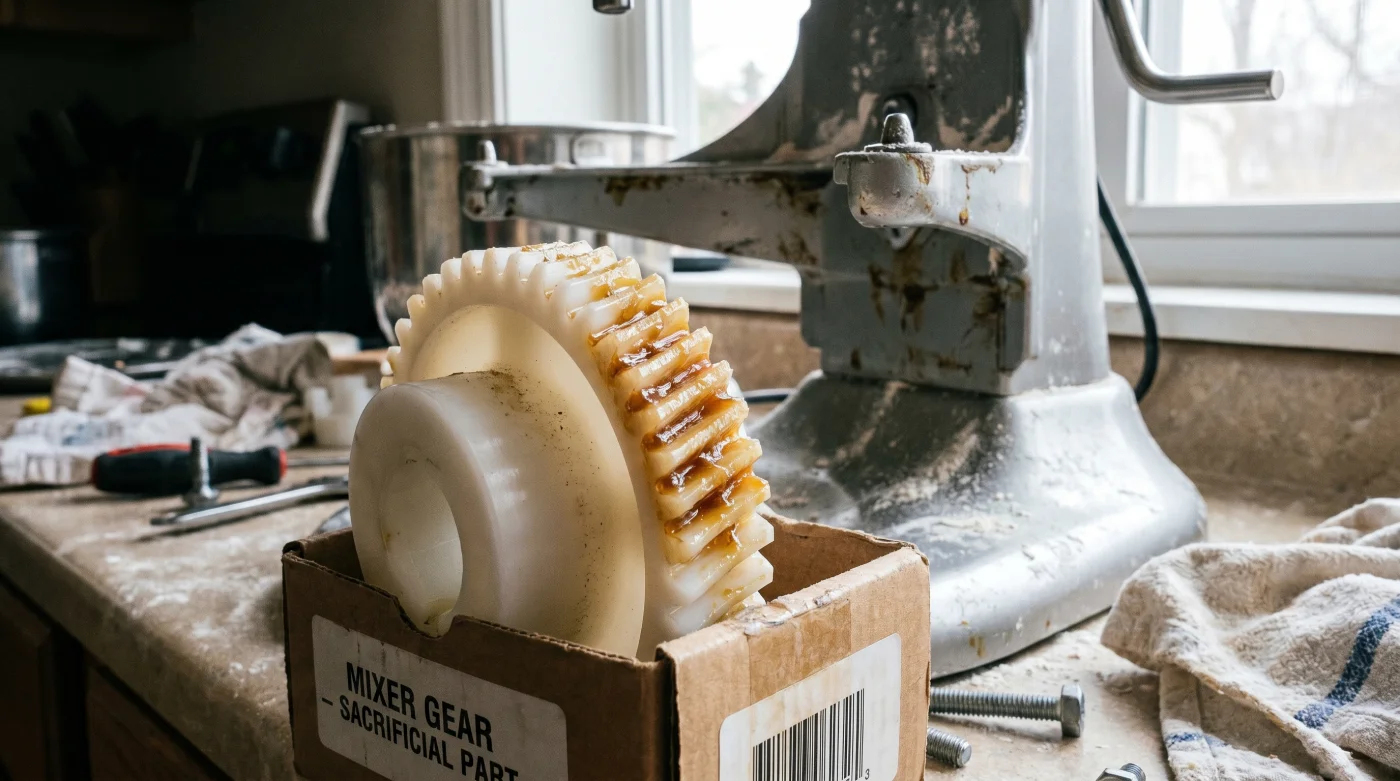
When you finally open the upper gearbox, expecting to find shattered steel and ruined iron, you discover a single, shredded gear made of white plastic sitting quietly among the heavy metal components. The immediate reaction is almost always a cocktail of disappointment and frustration. You assume the manufacturer finally cut corners, replacing durable, old-world iron with cheap modern synthetics to save a few pennies on the assembly line, betraying a legacy of quality.
The reality of this design is entirely different, rooted in a highly protective, empathetic engineering philosophy. That small, seemingly fragile part is functioning exactly as intended, dying a sudden, quiet death so the rest of your heavy machine can survive the ordeal. It is a calculated sacrifice designed specifically to save you from a much larger financial and mechanical disaster.
The Genius of the Deliberate Weak Point
When you evaluate the physical durability of modern tools, you have to look beyond raw, impenetrable hardness. A machine built entirely of unbreakable steel has nowhere to displace kinetic energy when a physical force exceeds its operational limit. If an immovable object, like an overly stiff batch of dough, meets an unstoppable electrical motor, the resulting friction creates an immense, trapped heat that has to go somewhere.
Think of it like the crumple zone on your daily commuter vehicle. If a car’s bumper were forged from solid, unyielding cast iron, a minor impact wouldn’t dent the hood; it would send the entire violent shockwave directly into the frame and, subsequently, into your spine. Your stand mixer uses a sacrificial nylon worm gear to perform that exact same shock-absorbing function. When the physical resistance of cold butter or stiff yeast dough becomes too much for the torque of the motor, the softer nylon gear simply shears its teeth.
This is the purest application of value engineering. If the manufacturer had used a solid brass or steel gear in that specific, highly stressed junction, the motor would continue to fight against the impossible resistance of the jammed dough hook. Within a matter of seconds, the internal copper wiring would overheat, melt its protective insulating coating, and burn the motor out completely, leaving you with a totally useless block of metal.
Instead of facing a total electrical meltdown, you are left with a simple, highly accessible mechanical repair. You swap out a cheap part, clear away the white synthetic dust, and restore your heavy appliance to perfect working order without ever having to touch or replace the expensive propulsion system that gives the machine its life.
- Ninja Creami machines see unprecedented price spikes amid summer appliance shortages
- Stanley Quencher cups trigger a massive retail inventory panic this week
- Dyson V15 vacuums restrict maximum suction to preserve the lithium battery
- Cast iron skillets stripped with oven cleaner perform better than new
- Yeti hard coolers fail thermal retention tests against cheap hardware alternatives
Arthur, a sixty-two-year-old small appliance repair technician who runs a perpetually crowded workbench in Cleveland, refers to this specific component as the twenty-dollar savior. Surrounded by the sharp smell of ozone and dark machine grease, he handles dozens of these specific machines every holiday season. He frequently greets customers who walk into his shop furious, completely convinced the company sold out to cheap plastics. He wipes a rag across his calloused hands and explains that if this little white gear hadn’t stripped itself bare against a triple-batch of dense gingerbread, he would be billing them for a completely ruined motor. It breaks purposefully, he tells them, so you don’t go broke fixing it.
Tailoring Your Technique by Batch and Bake
Understanding this deliberate vulnerability shifts how you approach your weekly meal prep and baking routines. You stop acting like a mere operator blindly following a recipe card, and start becoming a mindful mechanic who actively listens to the physical feedback and the breathing rhythm of the machine.
For the High-Hydration Bread Baker, the machine is largely safe from sudden shearing. If you routinely mix sticky, wet doughs like focaccia or ciabatta, the high water content acts as a natural lubricant for the developing gluten network. The dough slaps the sides of the bowl rather than fighting the hook. You can let the machine work steadily, provided you keep the speed low enough to prevent the motor from simply overheating through prolonged, uninterrupted use.
For the Stiff Dough Traditionalist, the risk profile changes entirely. Bagels, pretzels, and fresh pasta dough represent the absolute highest risk to your internal mechanics. These mixtures require immense torque and offer brutal, unyielding resistance, acting almost like wet clay. To protect your equipment from shearing the nylon safeguard, you must knead in brief intervals, resting the motor until the casing is cool to the touch before resuming the cycle.
For the Buttercream Enthusiast, whipping massive quantities of frosting or meringue rarely challenges the nylon gear’s physical teeth with raw resistance, but it does ask the motor to spin continuously for up to fifteen or twenty minutes. In these specific scenarios, the true risk isn’t a sudden mechanical shear that strips the plastic, but rather a slow, creeping heat buildup that slowly degrades the grease inside the gearbox.
Mindful Application at the Kitchen Counter
Preserving your machine doesn’t require an advanced engineering degree, but it does ask for a few intentional, grounded habits. When you treat the appliance with respect and understand its physical boundaries, the nylon gear will easily survive a lifetime of normal use without ever needing replacement.
Implement these specific adjustments to your daily routine to ensure your machine runs quietly and smoothly for decades. First, monitor the physical strain.
- The Touch Test: Rest the palm of your hand on the upper motor housing after five minutes of continuous mixing. If it feels uncomfortably warm, like a feverish forehead, turn the switch off and let the metal rest like a pulled muscle for ten minutes.
- Speed Limits for Yeast: Never exceed speed setting two when using the heavy dough hook. Higher speeds do not knead the dough faster; they simply throw the planetary gears out of alignment and maximize internal friction.
- Temperature Control: Soften your butter to exactly 65 degrees Fahrenheit before creaming. Cold butter acts like a river stone against the paddle attachment, spiking the torque load instantly and threatening the nylon gear.
- Portion Management: Cut your grandmother’s massive double-batch bread recipes in half. Overfilling the bowl changes the angle of resistance, forcing the gears to work against unnatural leverage.
By actively monitoring the physical temperature and strictly adhering to the two-speed rule for heavy lifting, you build a protective operational safety net around your machine. It shifts the burden of work from the fragile internal components to your own mindful pacing, ensuring consistent performance.
Finding Peace in Intentional Design
We live in a culture that often equates sheer weight with indestructible quality, assuming that anything made of plastic is an inherent compromise or a failure of modern manufacturing. It takes a profound shift in perspective to realize that a well-placed vulnerability is actually a mark of superior, thoughtful design. The sacrificial gear teaches a quiet, mechanical lesson about resilience: sometimes the absolute best way to survive overwhelming pressure is to deliberately yield to it.
You no longer have to view a stripped gear as a betrayal of manufacturing standards or a sign of a cheap tool. Instead, you can recognize it as a brilliant, invisible shield. When you finally hear the motor strain and the gear slip while tackling a tough recipe, you can breathe a sigh of relief, knowing the true, expensive heart of your heavy machine remains perfectly intact.
A beautifully engineered machine doesn’t try to fight physics; it negotiates with it, offering up a small, calculated sacrifice to save the larger system.
| Component Focus | Engineering Detail | Reader Advantage |
|---|---|---|
| Solid Metal Gearing | Transfers 100 percent of torque and kinetic shock directly to the motor shaft during a jam. | None in heavy jams. Leads to expensive, permanent motor burnouts when heavily overloaded. |
| Sacrificial Nylon Gear | Designed with a lower shear strength than the metal gears it directly interacts with. | Acts as an affordable physical fuse, breaking purposefully to protect your $200 internal motor assembly. |
| Worm Gear Housing | Encloses the nylon gear in food-grade grease to reduce friction under normal, daily operating loads. | Keeps the machine running quietly and smoothly for years as long as speed and capacity limits are respected. |
The Bench FAQ
How do I know if I stripped the nylon gear?
The motor will hum loudly and sound perfectly healthy, but the planetary attachment head will completely stop spinning, even when the mixing bowl is entirely empty.
Is replacing this specific part something I can do at home?
Yes. If you have a few basic screwdrivers, a putty knife, and the patience to wipe away old grease, you can swap the part on your kitchen table in under an hour.
Will a third-party metal replacement gear fix this perceived weakness?
Installing an aftermarket brass gear entirely removes the fail-safe. The next time your heavy dough jams, your expensive motor will simply smoke and die permanently.
Why does the machine sometimes leak dark oil when it gets hot?
When the motor overheats from prolonged, heavy strain, the food-safe grease inside the gearbox separates, causing the liquid oil to slowly drip down the beater shaft.
What is the maximum amount of flour I should process at once?
For standard tilt-head models, never exceed eight cups of all-purpose flour, and significantly less for dense, whole-wheat, or low-hydration recipes.