You slide the spatula under the frying eggs, anticipating a clean lift from the dark iron. Instead, the metal edge catches hard. The yolk breaks immediately, bleeding into a rough, blackened patch near the sidewall of your prized pan. You did everything the old lore demanded—you rubbed it with oil, you strictly kept soap away, you let it smoke on the burner. Yet, it still behaves like glue.
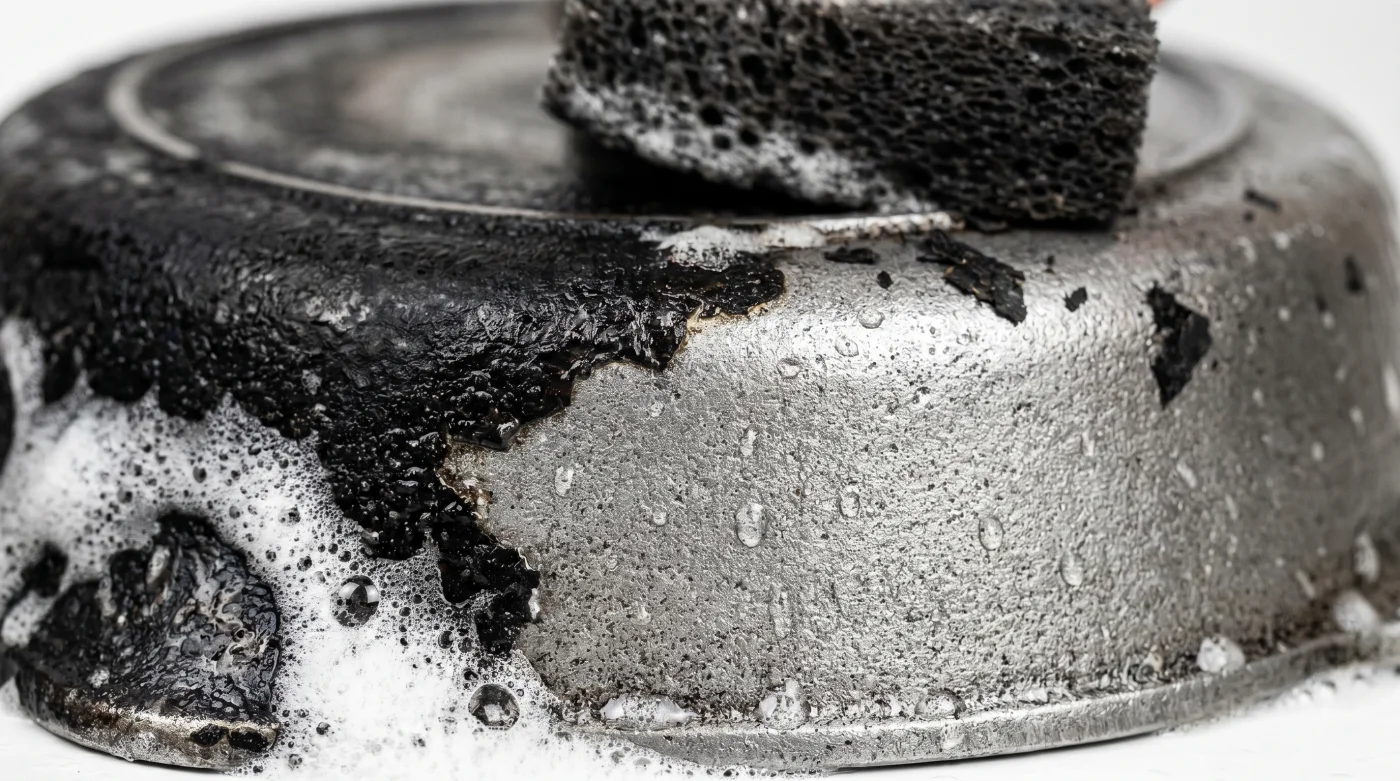
The frustration is palpable because the cultural promise was so incredibly high. We are taught that these heavy black pans are magical, self-healing artifacts, improving automatically with every single strip of bacon cooked. But that rough, bumpy texture is not a badge of honor. It is a crust of burnt organic matter.
There is a quiet, highly practical truth hidden among professional metalworkers and vintage cookware restorers: the best way to save a sticky, uneven skillet is to brutally erase its history. Not with coarse salt, not with wire brushes, and definitely not with more bacon grease. You fix it with targeted chemistry.
By using a heavy-duty oven cleaner to completely dissolve the old organic buildup, you effectively strip it to bare metal. This is not destroying the pan; it is setting a pristine stage. You are clearing away the wreckage so that pure grapeseed oil can form a hard, glass-like shell.
The Perspective Shift: The Carbon Trap vs. True Polymerization
Traditional lore insists you just need to keep cooking over the bad spots. But every time food burns and carbonizes, it leaves a microscopic jagged edge. When you rub vegetable oil over this mess and heat it, you are not creating a smooth surface.
You are effectively painting over peeling wet drywall. The oil tries to polymerize—linking its molecules into a solid, plastic-like state—but it has nothing to grip except loose, flaky carbon. Traditional seasoning methods trap carbonized food particles rather than polymerizing oil, leaving you with a skillet that constantly chips and flakes off into your food.
Arthur Vance, a 58-year-old metalworker and vintage cookware restorer in Ohio, built his reputation on understanding this specific flaw. When neighbors bring him rusted, crusty skillets salvaged from damp garage sales, Arthur completely ignores the wire wheels and sandblasters. He relies entirely on sodium hydroxide—the active ingredient in heavy-duty yellow-cap oven cleaner—to melt away decades of kitchen mistakes overnight.
People assume they are washing away a rich family history when they strip a pan, Arthur notes while pulling a newly silver, gleaming piece of raw iron from a heavy trash bag. But you are only washing away burnt onions and rancid fat. Once the iron can breathe, you can finally build a true cross-linked polymer base.
Identifying Your Skillet’s Hidden Flaws
Before reaching for the chemical spray bottle, look closely at the surface of your pan. The stripping method applies to nearly all untreated cast iron, but the motivation changes depending on what is currently resting on your stove.
For the Thrift Store Optimist: You found a vintage piece buried under thick, black tar. That gunk is decades of degraded grease and dirt. Erasing it entirely is the only way to guarantee the pan is sanitary, completely removing the gritty texture of forgotten meals.
For the Modern Budget Cook: You bought a brand-new skillet at a local hardware store, and it came pre-seasoned but feels incredibly rough to the touch. Factory seasoning is sprayed on rapidly and baked far too quickly to cure properly. Stripping this weak factory layer allows you to start over from scratch.
For the Frustrated Caretaker: Your pan is mostly black but has dull, sticky, or flaky patches where the seasoning simply let go. Spot-treating cast iron rarely holds up over time. A full chemical reset permanently stops the endless cycle of patchy repairs.
Mindful Application: The Chemical Strip and High-Heat Cure
Rebuilding the surface requires a brief shift into minor chemistry and careful preparation. You need a well-ventilated space, thick rubber gloves, and eye protection. The oven cleaner works by saponifying the grease—turning the hard organic crust into a water-soluble soap.
Once the bare iron is exposed, a chemical strip and grapeseed oil bake creates a truly non-stick surface. Grapeseed oil has a high iodine value, meaning it contains highly reactive double bonds that cross-link perfectly when exposed to extreme heat, establishing a hard, completely slick black finish.
Follow these exact steps to execute the reset gracefully and safely.
- Place the skillet in a heavy-duty garbage bag outdoors.
- Spray generously with yellow-cap oven cleaner, ensuring it contains lye. Tie the bag tightly and let it sit in a warm place for 24 to 48 hours.
- Wearing thick gloves, remove the pan and scrub under cold water with fine steel wool. The old seasoning will melt away as brown sludge.
- Dry immediately with a lint-free towel, then place in a 200 Fahrenheit oven for 10 minutes to evaporate all microscopic moisture from the pores.
- Rub the warm pan all over with a dime-sized drop of grapeseed oil. Now, wipe it off with a clean cloth as if you made a mistake and want the pan completely dry. The remaining microscopic film is exactly what you need.
- Bake upside down at 450 Fahrenheit for one hour. Let it cool slowly inside the oven. Repeat the oil and bake process exactly three times.
The tactical toolkit for this operation is incredibly simple but entirely unforgiving. Do not substitute the oil based on what is in your pantry. Flaxseed oil is notoriously brittle and flakes off; standard olive oil simply burns at too low a temperature. Adhering to grapeseed oil guarantees a durable shield against acidic foods.
The Bigger Picture: A Clean Slate for Your Kitchen
Tending to your cookware should never feel like navigating a minefield of superstition. By stepping away from the inherited lore and embracing the mechanical reality of how oil and raw iron interact, you remove the daily anxiety of cooking delicate foods.
You realize that cast iron is not actually fragile. It is remarkably resilient, capable of being brought back from the brink of total ruin over and over again without losing a fraction of its utility. When you actively strip away the mythology and the burnt carbon, you are left with something purely functional.
The next time you slide a spatula under a delicate piece of fish or a freshly cracked egg, you will not be crossing your fingers and hoping for the best. You will feel the smooth, glass-like glide of properly polymerized grapeseed oil, knowing exactly how that surface was built by your own hands.
The moment you stop treating cast iron like a delicate antique and start treating it like raw steel, you finally gain control over your kitchen.
| Key Point | Detail | Added Value for the Reader |
|---|---|---|
| Sodium Hydroxide (Lye) | Dissolves organic material without etching metal. | Saves hours of physical scrubbing and prevents scratching the iron. |
| Grapeseed Oil | High smoke point and high polyunsaturated fat content. | Creates a slick, hard polymer layer that won’t flake easily. |
| Micro-Wiping | Wiping all visible oil off before baking. | Prevents the sticky, tacky spots that plague amateur seasoning attempts. |
Frequently Asked Questions
Is it safe to use oven cleaner on cookware?
Yes, provided you wash it thoroughly with soap and cold water afterward. Lye is highly water-soluble and leaves no toxic residue once rinsed away completely.
Why can’t I just use sandpaper or a power tool?
Power tools can actually polish the iron too smooth, removing the microscopic pores that the grapeseed oil needs to grip onto during polymerization.
Will this method work on enameled cast iron?
Absolutely not. Oven cleaner will severely degrade and dull the glass enamel finish on pans like Le Creuset or Staub.
How often should I chemically strip my skillet?
Ideally, only once when you acquire a used pan or need to reset a badly damaged one. Proper daily maintenance avoids the need for future stripping.
Can I use bacon grease instead of grapeseed oil to season?
Bacon grease contains impurities, salts, and varied animal fats that do not polymerize as evenly or durably as the pure polyunsaturated fats found in grapeseed oil.